
Both Pilates and Yoga will tighten your midsection, build strength, increase your stamina and flexibility, help you stand taller, and feel healthier. And both are "mind-body" programs that require concentration and consistent practice and will help to relieve stress. And while many of the exercises in Yoga and Pilates can look similar, their execution is very different causing them to target different muscles and have different levels of endurance.
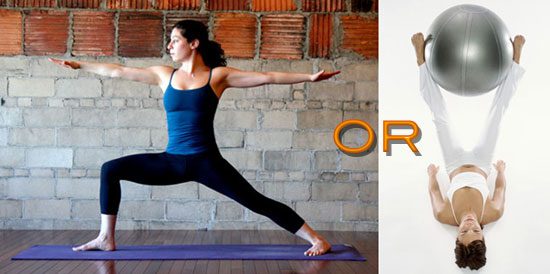
Pilates may seem similar to Yoga because it was developed with Yoga exercises as part of its inspiration. Pilates was developed by Joseph Pilates initially to mainly to be used as therapy for bed-ridden injured soldiers to re-build strength. It is for this reason that in Mat Pilates, exercises are performed supine, prone or in a side-lying position. Because of this, they are more accessible for people with knee, rotator cuff and back problems. Pilates with a well-trained instructor is excellent pre-and post-operative therapy. And even people with regular back pain caused by stress or bad posture from sitting at a computer tell me all the time how much of a difference Pilates was making for them.
Yoga class on the other hand typically include standing, balancing, seated postures and inversions, such as shoulder stand, crow pose or headstand asanas. Some of these poses can be hard for people with joint and balance issues. But that shouldn't scare you away from Yoga! Just make sure if you have knee, ankle, spinal issues or any recent injury, to let your instructor know so they can give you safe modifications. I personally really do not like going upside down so I find myself enjoying a quiet break in child's pose during that time in Yoga class. Don't let yourself be intimidated in Yoga class. It is easy to look around at these people chilling on their heads and doing crazy acts of contortion and want to run your asana right out of the room.
 |
| "Yes Sunshine. Nice. Now come on everyone. It's easy. Just get on your head and we'll be staying there for the rest of class." |
Pilates is also an excellent cross-trainer for athletes because of the focus it brings to developing core strength which will then increase balance, flexibility, endurance, agility decreasing their chances for injury. Many people and professional athletes and dancers find Pilates to be a secret weapon for them as runners, dancers, golfers, skiers.
What it all comes down to is what is best for you and what you like to do. The best is to try them both and remember that good instructors make a difference so try different classes to find the one that suits you best. It is a growing trend for many Pilates instructors to infuse Yoga with their Pilates class (aka Yogilates) so that may be right up your alley-though note that many purists of the two practices consider this to be as preposterous as merging pickles and chocolate. As I see it, Yoga and Pilates are both wonderful ways to feel and look great. And I haven't tasted anything dipped in chocolate that I haven't liked.
 |
| Case in point-these "exotic" chocolate bars fuse bacon, plantains, curry, chillies, wasabi, and mushrooms to create delicious delectable treats! Check them out for at www.vosgeschocolate.com! And then come to Pilates to work them off! ;-) |

No comments:
Post a Comment